

CBSE Class 12 Physics: Mastering Key Derivations and Numericals with a Private Tutor
Master the top 30 CBSE Class 12 Physics derivations and tricky numericals with step-marking techniques and dedicated 1-on-1 private tuition.
- 1. The Anatomy of CBSE Class 12 Physics: Derivations, Concepts & Numericals
- 2. The Top 30 High-Yield Derivations Every Class 12 Student Must Master
- 3. Decoding CBSE Step-Marking: How to Score Full Marks on 5-Mark Questions
- 4. Eliminating Numerical Phobia: A Methodical 4-Step Problem-Solving System
- 5. Why 1-on-1 Physics Mentorship Beats Large Batch Coaching for Board Success
- 6. The 60-Day Physics Preparation Blueprint: Weekly Drills & Revision Checklist
1. The Anatomy of CBSE Class 12 Physics: Derivations, Concepts & Numericals
Ask any Class 12 Science student which subject triggers the most anxiety before pre-boards, and the answer is almost universally the same: CBSE Physics. Unlike Class 10 Science where conceptual recall and standard textbook questions often suffice, Class 12 Physics demands a synthesis of calculus-based mathematical rigor, conceptual visualization, and precise board-standard presentation.
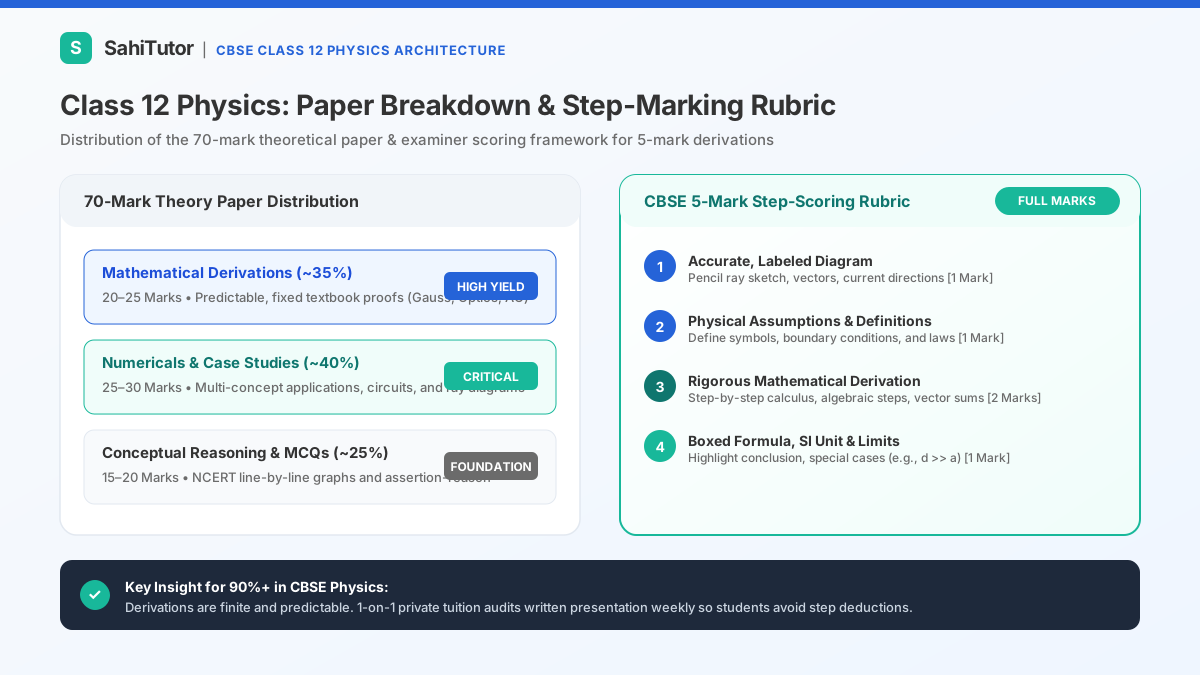
The 70-mark CBSE Physics theoretical paper is structurally divided into three core pillars: mathematical derivations (accounting for roughly 20–25 marks), quantitative numericals and case-based applications (around 25–30 marks), and conceptual/graphical reasoning (approx 15–20 marks). Many capable students who grasp theoretical concepts during classroom lectures stumble severely during exams because they fail to convert their understanding into step-by-step written derivations and error-free numerical calculations.
Understanding this distribution is the first step toward high performance. Derivations represent the most predictable, high-scoring component of the entire syllabus. While conceptual MCQs and twisted numericals can vary wildly from year to year, the core governing derivations—such as Gauss's Law applications, Biot-Savart Law, Lens Maker's Formula, and the Wave Theory of light—are fundamentally fixed.
2. The Top 30 High-Yield Derivations Every Class 12 Student Must Master
Rather than feeling overwhelmed by the 14 chapters in NCERT Volumes 1 and 2, high-scoring students categorize derivations by their unit weightage and recurring frequency in past 10-year CBSE board papers. Below is the curated master list of the top high-yield derivations categorized across the primary syllabus clusters.
- Electrostatics & Current Electricity: Electric field due to an electric dipole (axial and equatorial), Gauss's Law applications (infinitely long straight wire, uniformly charged infinite plane sheet, spherical shell), Capacitance of a parallel plate capacitor (with and without dielectric slab), Drift velocity and its relation to electric current (Ohm's Law microscopic deduction), and Kirchhoff's laws application to Wheatstone bridge.
- Magnetism & Electromagnetic Induction: Magnetic field on the axis of a circular current loop (Biot-Savart Law), Force between two parallel current-carrying conductors and definition of one Ampere, Torque on a magnetic dipole in a uniform magnetic field, Moving Coil Galvanometer principle and conversion into ammeter/voltmeter, Motional EMF, Mutual and Self-inductance of long solenoids, and AC Generator principle and working.
- Alternating Current & Electromagnetic Waves: Impedance, phase angle, and resonance in a series LCR circuit (using phasor diagrams), Average power associated with an AC circuit, and Displacement current derivation via Ampere-Maxwell Law.
- Ray & Wave Optics: Mirror formula and Refraction at a spherical surface, Lens Maker's Formula, Refraction through a prism (angle of minimum deviation), Astronomical Telescope and Compound Microscope (ray diagrams and magnifying power in normal adjustment and near point), Huygens' Principle proof of Laws of Reflection and Refraction, and Conditions for constructive and destructive interference in Young's Double Slit Experiment (YDSE).
- Modern Physics: Einstein's Photoelectric Equation deduction, Bohr's postulates: Radius of electron orbit and total energy in hydrogen atom, De Broglie wavelength of an electron, and Energy band diagrams for conductors, semiconductors, and insulators.
3. Decoding CBSE Step-Marking: How to Score Full Marks on 5-Mark Questions
A common tragedy among Class 12 students is spending 15 minutes writing a lengthy derivation only to receive 3 out of 5 marks. In CBSE board evaluations, examiners follow strict marking schemes where every mark is compartmentalized into specific milestones.
In a standard 5-mark derivation, marks are typically allocated as follows: 1 mark for a neatly labeled, accurate ray or circuit diagram; 1 mark for stating the initial physical assumptions and defining variables; 2 marks for mathematically rigorous algebraic progression with clear reasons; and 1 final mark for highlighting the end formula, specifying its SI unit, and noting limiting physical conditions (e.g. when distance d >> a).
Omitting a neat diagram or skipping intermediate steps costs marks instantly. Working 1-on-1 with an experienced private tutor trains students to treat each derivation as an architected blueprint, eliminating careless deductions.
“In CBSE Physics, an examiner does not just read your final equation—they grade the logical bridge from your initial diagram to your concluding statement. Master the rubric, and derivations become guaranteed marks.”
4. Eliminating Numerical Phobia: A Methodical 4-Step Problem-Solving System
Numericals in Class 12 Physics strike terror into many students because questions often weave multiple concepts into a single narrative—such as combining Gauss's Law with kinematic projectile motion, or combining AC resonance with quality factor calculations.
The secret to cracking complex physics numericals lies in a reproducible, methodical four-step framework practiced routinely during 1-on-1 tutoring sessions:
5. Why 1-on-1 Physics Mentorship Beats Large Batch Coaching for Board Success
In large coaching batches of 50 to 100 students, the lecture moves at a relentless, predetermined pace. If a student is confused by vector resolution in Biot-Savart Law or cannot visualize wavefront propagation in Huygens' principle, the coaching batch moves forward regardless. Over months, small conceptual gaps compound into severe pre-board panic.
In contrast, dedicated 1-on-1 home or online tutoring provides immediate, personalized diagnostic support. A verified SahiTutor Physics educator sits alongside the student, watches them write derivations in real-time, identifies the precise line where algebraic hesitation occurs, and reconstructs foundational calculus or vector concepts on the spot.
Furthermore, personal tutors tailor the prep cycle to the student's specific school pre-board timelines, conducting timed answer-writing simulations that mirror CBSE examiner expectations.
6. The 60-Day Physics Preparation Blueprint: Weekly Drills & Revision Checklist
Whether you are preparing for December pre-boards or the final March CBSE examination, a focused 60-day structured roadmap can comfortably transform a student scoring 40/70 into a 65+/70 performer. Use the following weekly action protocol in collaboration with your private tutor:
Find a verified 1-on-1 Physics tutor for CBSE Class 12 — book a free demo class today
Submit a free requirement in under 60 seconds. We'll find qualified tutors matching your location, curriculum, and budget, and arrange a trial demo class.
Related Guides & Articles
View allClass 10 & 12 Board Exam Prep: How a Private Home Tutor Boosts Scores by 20–30%
Proven study blueprints, syllabus timelines, and revision routines for CBSE & ICSE Class 10 & 12 board exams. Learn how dedicated private tutoring eliminates exam anxiety.
CBSE Class 10 Maths: Why 1-on-1 Tutoring Solves Pre-Board Anxiety
Discover how personalized 1-on-1 tutoring helps Class 10 students overcome Mathematics anxiety, master NCERT, and score 90%+ in CBSE board exams.
1-on-1 Personalized Tutoring vs Coaching Institutes: Which Delivers Better Results?
A comprehensive comparison between 1-on-1 private home tutoring and large coaching institutes. Discover which format suits your child's learning personality and academic goals.