

How Many Days a Week Should Your Child Have Home Tuition? (3 Days vs 5 Days Guide)
Should your child have home tuition 3 days or 5 days a week? Compare scheduling trade-offs, fatigue factors, and use our practical 4-step decision framework.
- Why Tuition Frequency Is a Critical Decision (Not a Universal Formula)
- The 3-Day Model: When More Space Between Sessions May Help
- The 5-Day Model: When More Frequent Support May Make Sense
- Fewer Sessions vs. More Frequent Sessions: A Trade-Off Comparison
- A 4-Step Framework to Determine Your Child's Schedule
- What Learning Science Can (and Cannot) Tell Us About Scheduling
- References & Authoritative Sources
Why Tuition Frequency Is a Critical Decision (Not a Universal Formula)
When families decide to arrange private home or online tutoring, one of the first practical questions that arises is deceptively simple: *How many days each week should the tutor come?*
In many households, default assumptions take over. Some parents assume that more days automatically equate to faster progress, scheduling tuition five or six evenings a week. Other families opt for two or three days simply because it fits neatly around sports or school transport. Yet educational experience demonstrates that neither schedule is inherently superior. Tutoring frequency is not a one-size-fits-all formula, and there is no universal number of days that works for every student.
A student's academic week already contains numerous demands: six to seven hours of formal schooling, daily school homework, test preparation, travel time, and the essential need for physical play and rest. Introducing a private educator into this ecosystem alters the child's daily rhythm. If the frequency is too sparse, a child with severe conceptual confusion may stay stuck for days between sessions. Conversely, if the schedule is too crowded, tutoring can inadvertently cannibalize the independent study time a student needs to consolidate ideas on their own.
The objective of this guide is not to argue that 3 days is 'better' than 5 days, or vice versa. Instead, it provides parents with an objective framework to evaluate their child's specific academic needs, study habits, school workload, and fatigue levels—helping families design a sustainable routine that supports genuine understanding.
The 3-Day Model: When More Space Between Sessions May Help
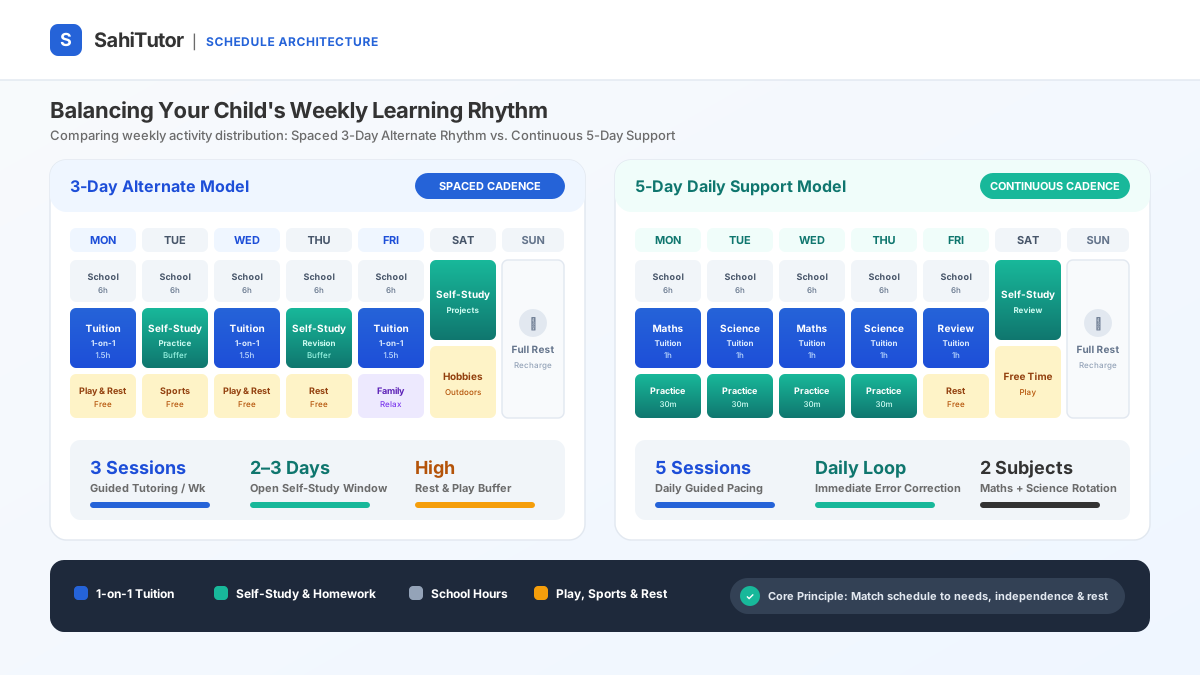
A schedule of three sessions per week—frequently arranged on alternate days such as Monday, Wednesday, and Friday—is one of the most widely adopted formats in home and online tutoring. Rather than viewing this as a 'budget' or 'light' option, educators recognize that an alternate-day schedule offers distinct structural characteristics.
The primary advantage of having days between sessions is the creation of an independent application buffer. When a tutor introduces a new concept—for example, quadratic equations in Class 10 Mathematics or chemical stoichiometry in Class 11—the student needs opportunity to solve problems unassisted. In a three-day schedule, Tuesday and Thursday serve as natural practice windows where the student attempts assigned exercises independently, confronts unexpected difficulties, and identifies specific questions for the next session.
This spaced cadence can be particularly advantageous in scenarios such as:
• **Single-Subject Focus:** When a student is performing well across most subjects but requires focused guidance in a single challenging area (such as Physics or Higher Mathematics).
• **Moderate to High Learner Independence:** Students who already possess reasonable self-discipline and can complete homework without an adult sitting beside them.
• **Heavy School or Extracurricular Demands:** Children enrolled in sports, performing arts, or schools with extensive project workloads, where daily evening tuition would leave virtually no personal downtime.
However, the three-day model also has operational constraints. If a student has severe foundational gaps across multiple subjects, or struggles significantly with sustained attention during self-study, an alternate-day rhythm may leave too much unguided time. Without disciplined follow-through between sessions, difficulties can accumulate rather than resolve.
Independent problem-solving is where understanding turns into retention. An alternate-day tutoring schedule creates dedicated space for students to test their own comprehension before the next guided session.
The 5-Day Model: When More Frequent Support May Make Sense
A five-day schedule—typically Monday through Friday—represents a much more intensive tutoring commitment. Rather than treating daily tutoring as the default standard of academic diligence, parents should understand the specific educational circumstances where this level of regularity provides genuine value.
The defining characteristic of frequent tutoring is the immediate feedback loop. When a child experiences high anxiety or deep-seated confusion in multiple disciplines, attempting to work alone can lead to frustration and avoidance. A tutor who visits daily can provide structured pacing, break complex multi-subject syllabi into manageable daily milestones, and correct misconceptions on the spot before flawed reasoning becomes habitual.
Scenarios where a five-day schedule often makes practical sense include:
• **Multi-Subject Academic Coverage:** When a middle-school or secondary student requires dedicated support across two or three core subjects—such as Mathematics, Science, and English/Social Science—rotating them systematically throughout the week.
• **Bridging Significant Foundational Gaps:** Students transitioning across boards (such as State Board to CBSE or ICSE) or recovering from prolonged learning disruptions who need close, daily scaffolding to rebuild foundational confidence.
• **Executive Function & Study Habit Formation:** Younger learners or easily distracted students who struggle to initiate study sessions independently and benefit from predictable daily routine and structured accountability.
• **Pre-Exam Revision Phases:** Short-term, concentrated phases in the weeks preceding pre-board or annual examinations where daily problem review and past-paper analysis help stabilize performance.
The principal risk of a five-day schedule is academic dependency and mental fatigue. If a tutor is present every evening guiding every exercise, the student may develop the habit of passive listening rather than active cognitive wrestling. Furthermore, long school days combined with daily evening instruction can lead to diminishing cognitive returns if the child is chronically overtired.
Fewer Sessions vs. More Frequent Sessions: A Trade-Off Comparison
To decide what structure best suits your household, it is helpful to weigh the inherent trade-offs between schedules with more space versus schedules with higher frequency. Neither model represents an absolute ideal; each emphasizes different pedagogical dynamics.
The following objective comparison outlines how these two general structures compare across key operational and learning dimensions:
A 4-Step Framework to Determine Your Child's Schedule
Rather than guessing an arbitrary number of days, parents can follow a structured four-step evaluation process to establish a sensible tutoring frequency.
### Step 1: Identify the Actual Academic Problem
Begin by diagnosing the exact nature of the difficulty. Is your child struggling with advanced concepts in a single subject like Class 12 Physics, or are they overwhelmed by homework completion across Maths, Science, and Social Science? Are they capable of solving problems once shown an example, or do they experience immediate paralysis when opening a textbook? Clarifying whether the bottleneck is conceptual depth, multi-subject volume, exam technique, or daily consistency immediately clarifies how much guided contact is necessary.
### Step 2: Audit the Child's Existing Weekly Workload
Map out your child's actual 24-hour routine across the school week. Calculate the total hours spent in school, bus commute, existing extracurricular activities, and basic family meals. Crucially, calculate how much uncommitted time remains for genuine rest and sleep. If a student is already arriving home at 4:30 PM mentally drained, scheduling a 90-minute tutoring session five evenings a week can push sleep past midnight, triggering chronic sleep deficits that impair cognitive performance during the school day.
### Step 3: Match Session Frequency to Need and Independence
Synthesize the academic need with the student's level of independence. If the need is targeted to one subject and the student has the capacity to practice on alternate days, a 2- to 3-day schedule provides optimal balance. If the student has significant foundational deficits across multiple disciplines or requires close external structure to stay engaged, a 4- to 5-day schedule may be warranted—provided total daily hours are kept concise and well-paced.
### Step 4: Review and Adjust Based on Observed Response
Educational plans should never be treated as permanent contracts. After initiating a schedule, observe the child's response over a reasonable period—such as four to six weeks. Evaluate concrete indicators:
• Is the child approaching tutoring sessions with energy, or with visible dread and fatigue?
• Is homework completion improving, and is the student beginning to attempt problems before the tutor arrives?
• Are school test marks and classroom confidence reflecting genuine conceptual grasp?
If a child on a five-day schedule appears passive and tired, reducing frequency to three focused days with designated self-study intervals often revitalizes motivation. Conversely, if a three-day schedule leaves too many unanswered questions piling up, a temporary increase in frequency can provide needed stability.
What Learning Science Can (and Cannot) Tell Us About Scheduling
In discussions about tutoring, educational buzzwords are frequently cited to justify commercial packages. It is essential for parents to understand what empirical educational and cognitive research actually demonstrates—and where research boundaries end.
### What Cognitive Science Demonstrates
Cognitive psychology provides robust findings regarding how the human brain processes, consolidates, and retrieves information:
1. **Distributed (Spaced) Practice:** Landmark meta-analyses in cognitive science (such as Cepeda et al., 2006, and Dunlosky et al., 2013) demonstrate that distributing learning episodes over time results in superior long-term retention compared to massing practice in single, concentrated bursts. Spacing allows memory traces to consolidate and requires active retrieval upon re-encountering material.
2. **Cognitive Load and Working Memory:** Cognitive Load Theory (Sweller, 2011) emphasizes that working memory capacity is strictly limited. When learners are subjected to continuous instructional demands without adequate processing intervals, cognitive overload occurs, sharply diminishing the capacity to construct coherent mental schemas.
3. **The Impact of Timely Feedback:** Research on formative evaluation (Hattie & Timperley, 2007) establishes that immediate, specific feedback is among the most powerful drivers of learning gains. For students who hold fundamental misconceptions, unguided practice can inadvertently reinforce errors, whereas timely intervention redirects understanding.
### What Research Does NOT Say
While these empirical findings illuminate fundamental learning mechanisms, it is critical not to make unfounded inferences:
• Cognitive science does **not** test or prescribe specific commercial private tuition schedules. A study showing that spaced practice improves vocabulary retention does not mean that exactly 3 days of private home tuition is scientifically optimal.
• Similarly, findings on cognitive fatigue do not establish that 5 days of tutoring is universally harmful, just as findings on feedback do not prove that daily tuition is universally necessary.
• Official Indian educational bodies—including NCERT, CBSE, and CISCE—publish comprehensive regulations regarding school instructional hours, curriculum syllabi, and homework guidelines. However, these statutory bodies do not issue prescribed directives for private home tuition frequency. Private tutoring arrangements remain customized family decisions.
Understanding this distinction empowers parents: use scientific principles of spacing, manageable workload, and regular feedback to inform your thinking, but recognize that the exact schedule must be tailored to your child's unique reality.
References & Authoritative Sources
This guide draws upon established peer-reviewed literature in cognitive psychology, educational research, and statutory curriculum frameworks to support its discussion of distributed practice, memory consolidation, and instructional feedback.
References & Authoritative Sources
To maintain factual integrity, SahiTutor grounds research-informed statements in official curriculum frameworks, educational examination boards, and peer-reviewed educational literature.
- Distributed practice in verbal recall tasks: A review and quantitative synthesis — Psychological Bulletin (American Psychological Association)
- Improving Students' Learning With Effective Learning Techniques: Promising Directions From Cognitive and Educational Psychology — Psychological Science in the Public Interest
- Cognitive Load Theory — Psychology of Learning and Motivation (Elsevier)
- The Power of Feedback — Review of Educational Research (AERA)
Unsure how many days of tutoring your child actually needs? Discuss your child's specific subjects, school workload, and learning goals with a SahiTutor academic coordinator to match with the right verified home or online educator.
Submit a free requirement in under 60 seconds. We'll find qualified tutors matching your location, curriculum, and budget, and arrange a trial demo class.
Related Guides & Articles
View allHow to Choose the Right Home Tutor for Your Child: The Ultimate Parent Checklist (2026)
A step-by-step practical guide for parents on selecting the best home tutor or online tutor for CBSE, ICSE, or State Boards. Learn what questions to ask and how to evaluate demo classes.
Online Tuition vs Offline Home Tuition: Which Is Truly Right for Your Child in 2026?
A detailed side-by-side comparison of online tuition vs offline home tuition covering attention retention, convenience, safety, and cost savings.
Home Tuition Fees in India (2026 Guide): Hourly & Monthly Rates for CBSE, ICSE & State Boards
A complete breakdown of private home tuition and online tutor fees across Indian cities. Understand typical hourly and monthly costs by class, subject, and board.