

Overcoming Mathematics Phobia in School: 5 Steps Tutors Use to Rebuild Confidence
Is your child terrified of Maths? Discover the cognitive roots of mathematics anxiety in Classes 6-10 and the exact 5-step framework private home tutors use to restore confidence.
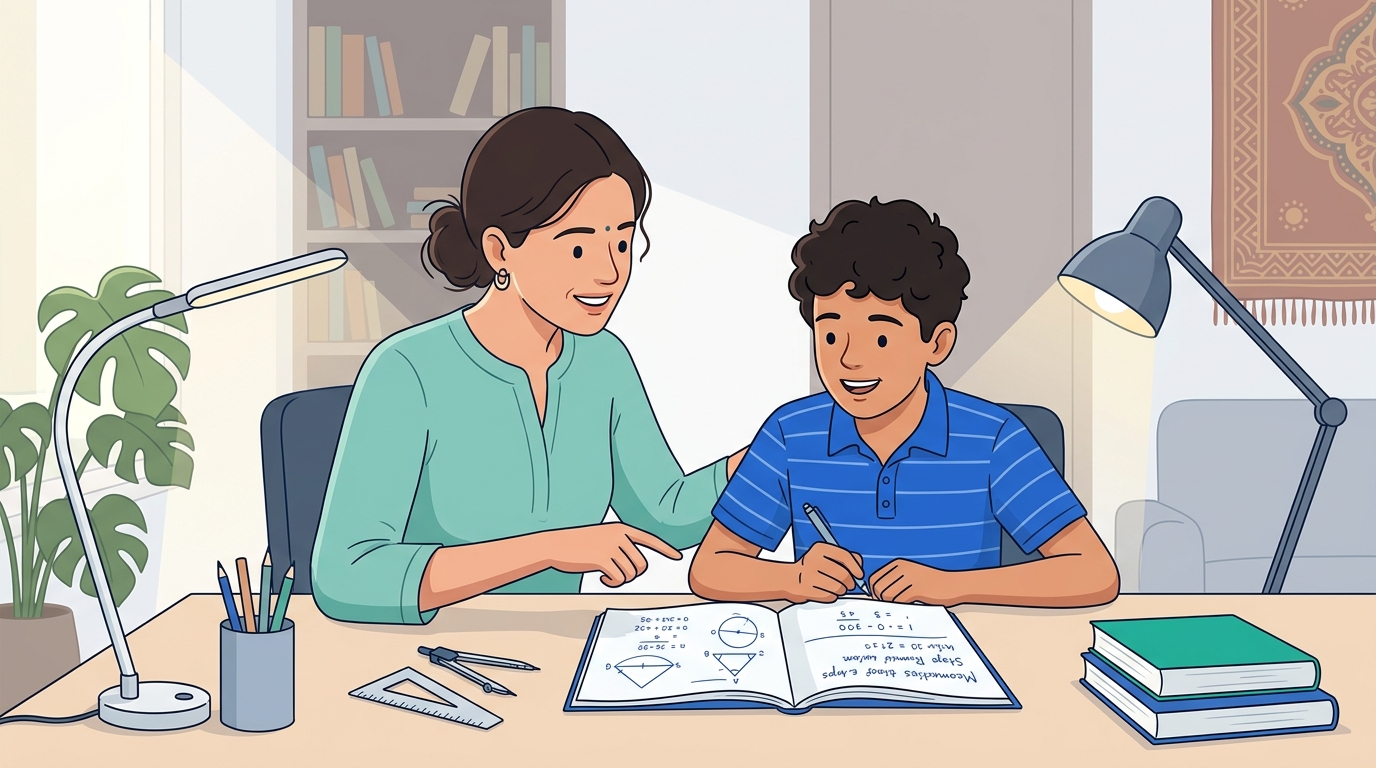
1. Understanding Maths Anxiety: It Is Not a Lack of Intelligence
Every academic year, thousands of capable students freeze when handed a mathematics test paper. Their palms sweat, simple arithmetic suddenly seems impossible, and a voice in their head whispers: 'I am just not a maths person.'
Cognitive research confirms that mathematics anxiety is a genuine physiological stress reaction, not an intellectual deficit. When anxiety spikes, the brain's working memory—the very mental bandwidth needed to hold numbers and formulas—is temporarily choked by fear.
Crucially, maths anxiety rarely begins because a child cannot think logically. It almost always traces back to an unaddressed foundational gap: a forgotten fraction rule in Class 5, confusion with negative integers in Class 6, or algebraic variables introduced too quickly in Class 7.
2. Why High-Density Classrooms Amplify Mathematics Fear
In a conventional school classroom with 40 to 60 students, teachers face strict curriculum deadlines. If a student hesitates during a lesson on linear equations, the teacher rarely has time to pause for 15 minutes and trace the confusion back to basic algebraic simplification.
Over time, the student stops raising their hand out of embarrassment. They copy board solutions passively without understanding the underlying reasoning. When tests arrive, the illusion of comprehension shatters, deepening their conviction that they are hopeless at the subject.
- Fear of public judgment: Shy students hesitate to reveal they didn't follow the teacher's explanation.
- Rigid syllabus schedules: Teachers must move to the next chapter regardless of individual mastery.
- The snowball effect: In mathematics, Chapter 4 depends strictly on Chapter 2. A single missed link derails future topics.
3. The 5-Step Confidence Framework Private Tutors Use
A seasoned 1-on-1 private home or online tutor uses a psychological approach to untangle fear before pushing for advanced problem-solving:
Step 1: The Diagnostic Re-wind. The tutor quietly diagnoses where the foundation cracked, often going two grades back to verify fractions, decimals, or signs without shaming the student.
Step 2: Low-Stakes Success. In the first two sessions, the tutor assigns problems calibrated to produce immediate 100% success, releasing dopamine and proving to the student that they can solve mathematics.
Step 3: Real-World Visual Analogies. Abstract formulas are tied to tangible concepts—like balancing a physical seesaw for algebraic equations or pizza slices for ratios.
Step 4: Think-Aloud Problem Solving. The student explains their thought process out loud while writing, allowing the tutor to catch sign mistakes before they derail the entire answer.
Step 5: Gradual Independence. The tutor transitions from co-solving to silent observation, building the student's endurance for independent exam conditions.
“When you remove the fear of making a mistake, mathematics transforms from a threatening test into an engaging puzzle.”
4. The 'Error Notebook' Habit: Turning Mistakes into Mastery
Top tutors swear by a simple, life-changing tool called the 'Error Notebook'. Whenever a student solves a question incorrectly during tuition, they do not erase it with an eraser.
Instead, they record the question in a dedicated notebook, draw a red circle around the exact line where the reasoning slipped (e.g. forgot to distribute the negative sign across brackets), and write one sentence explaining the slip. Re-solving these tagged problems every Sunday replaces anxiety with predictable accuracy.
5. What Parents Should (and Shouldn't) Say at Home
A parent's words directly shape a child's mathematical self-image. Research shows that parents who casually declare 'I was always terrible at maths too' unintentionally give their children psychological permission to give up.
Here is a constructive checklist for parents to foster resilience at home:
Help your child overcome maths anxiety with a patient, verified SahiTutor mentor today
Submit a free requirement in under 60 seconds. We'll find qualified tutors matching your location, curriculum, and budget, and arrange a trial demo class.
Related Guides & Articles
View allCBSE Class 10 Maths: Why 1-on-1 Tutoring Solves Pre-Board Anxiety
Discover how personalized 1-on-1 tutoring helps Class 10 students overcome Mathematics anxiety, master NCERT, and score 90%+ in CBSE board exams.
1-on-1 Personalized Tutoring vs Coaching Institutes: Which Delivers Better Results?
A comprehensive comparison between 1-on-1 private home tutoring and large coaching institutes. Discover which format suits your child's learning personality and academic goals.
How to Choose the Right Home Tutor for Your Child: The Ultimate Parent Checklist (2026)
A step-by-step practical guide for parents on selecting the best home tutor or online tutor for CBSE, ICSE, or State Boards. Learn what questions to ask and how to evaluate demo classes.