

How to Balance Chemical Equations by Counting Atoms
Learn how to balance chemical equations by changing coefficients and counting atoms on both sides. Follow a worked example and check your own practice answer.
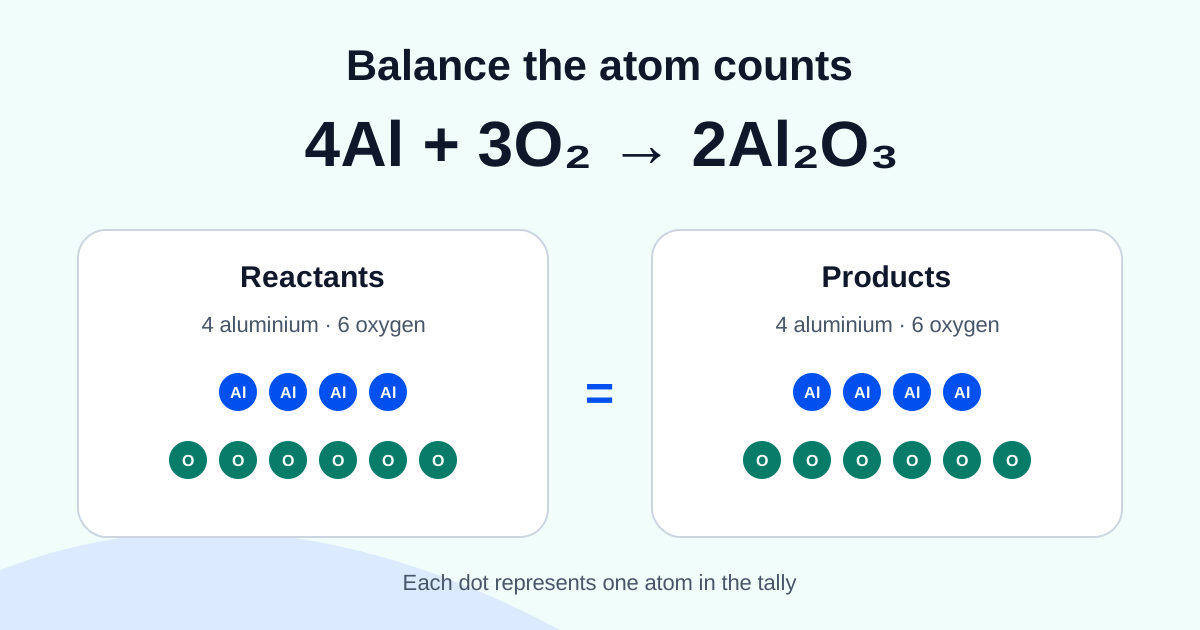
Count each element on both sides
If your chemical equation looks finished but one element has more atoms on the left than on the right, start with a tally. Write the element symbols down the side of a page and make a column for reactants and products. The equation is balanced when the count for each element agrees across the arrow.
This guide is for secondary-school chemistry students practising equations with the reactant and product formulas already given. The worked example uses aluminium oxide. Use the same counting method on a fresh equation before checking the answer below.
Use coefficients to change the number of units
A coefficient sits in front of a formula and multiplies the entire formula. In 2Al₂O₃, the front 2 gives 2 × 2 = 4 aluminium atoms and 2 × 3 = 6 oxygen atoms in the tally. A formula with no written coefficient counts once.
Keep the formulas supplied by the question intact. Subscripts specify the composition of a substance. Editing Al₂O₃ to make the arithmetic fit would change the given composition. See OpenStax Chemistry 2e, section 4.1 for the distinction between coefficients and subscripts.
If an element occurs in multiple terms on one side, add all its contributions. For example, CO₂ + 2H₂O contains 2 + 2 × 1 = 4 oxygen atoms in total.
Work through aluminium plus oxygen
Start with Al + O₂ → Al₂O₃. On the left the tally is Al 1, O 2. On the right it is Al 2, O 3. Oxygen is a useful starting point here because 2 and 3 share the small common multiple 6.
Place 3 in front of O₂ and 2 in front of Al₂O₃. Oxygen now totals 6 on both sides. Recount aluminium because the new coefficient changes both elements in the oxide. There are now 4 aluminium atoms on the right, so put 4 in front of Al on the left.
The final equation is 4Al + 3O₂ → 2Al₂O₃. The left has Al 4 and O 6. The right has Al 2 × 2 = 4 and O 2 × 3 = 6. The coefficients 4, 3 and 2 have no shared factor greater than 1.
Try a practice question before reading the answer
Balance Na + O₂ → Na₂O. Start with the oxygen count and write down which other element changes when you adjust the coefficient of Na₂O. Give yourself a moment to finish the tally before reading on.
One O₂ gives 2 oxygen atoms, so place 2 in front of Na₂O to reach 2 on the right. Those two units also contain 4 sodium atoms. Place 4 before Na. The result is 4Na + O₂ → 2Na₂O, with Na 4 and O 2 on each side. The unwritten coefficient of O₂ is 1.
If you stopped after changing Na₂O, the first step to repair is recounting sodium. Use that exact step as the focus of your next practice question. Our maths mock-test review guide shows how to turn a similar correction into a revision task.
Check the answer before moving on
Read the final equation once for formulas and once for counts. If all coefficients share a common factor, divide every coefficient by it and check the counts again. For further science practice, see the ICSE science preparation guide if that curriculum applies to you.
References & Authoritative Sources
To maintain factual integrity, SahiTutor grounds research-informed statements in official curriculum frameworks, educational examination boards, and peer-reviewed educational literature.
- Writing and Balancing Chemical Equations — OpenStax, Chemistry 2e (2019)
Supports: “Use coefficients while preserving formulas, and compare counts for each element.”
Looking for support with school chemistry? Share your subject, level and lesson preferences with SahiTutor to discuss a suitable tutor.
Submit a free requirement in under 60 seconds. We'll find qualified tutors matching your location, curriculum, and budget, and arrange a trial demo class.
Related Guides & Articles
View allHow to Review a Maths Mock Test and Plan Your Next Revision
Turn a marked maths mock test into a practical revision plan. Find the first wrong step, choose targeted practice and check your correction with a fresh question.
ICSE Class 10 Science (Physics, Chem, Bio): How 1-on-1 Tutoring Can Support Exam Preparation
Master ICSE Class 10 Science. Explore CISCE exam structures, examiner insights for Physics, Chemistry, and Biology, and a practical 4-step diagnostic framework.
CBSE Class 12 Chemistry: 60-Day Revision Blueprint
Prepare for CBSE Class 12 Chemistry with this 60-day revision blueprint. Explore how a structured approach helps navigate Organic, Physical, and Inorganic chapters.