

ICSE Class 10 Science (Physics, Chem, Bio): How 1-on-1 Tutoring Can Support Exam Preparation
Master ICSE Class 10 Science. Explore CISCE exam structures, examiner insights for Physics, Chemistry, and Biology, and a practical 4-step diagnostic framework.
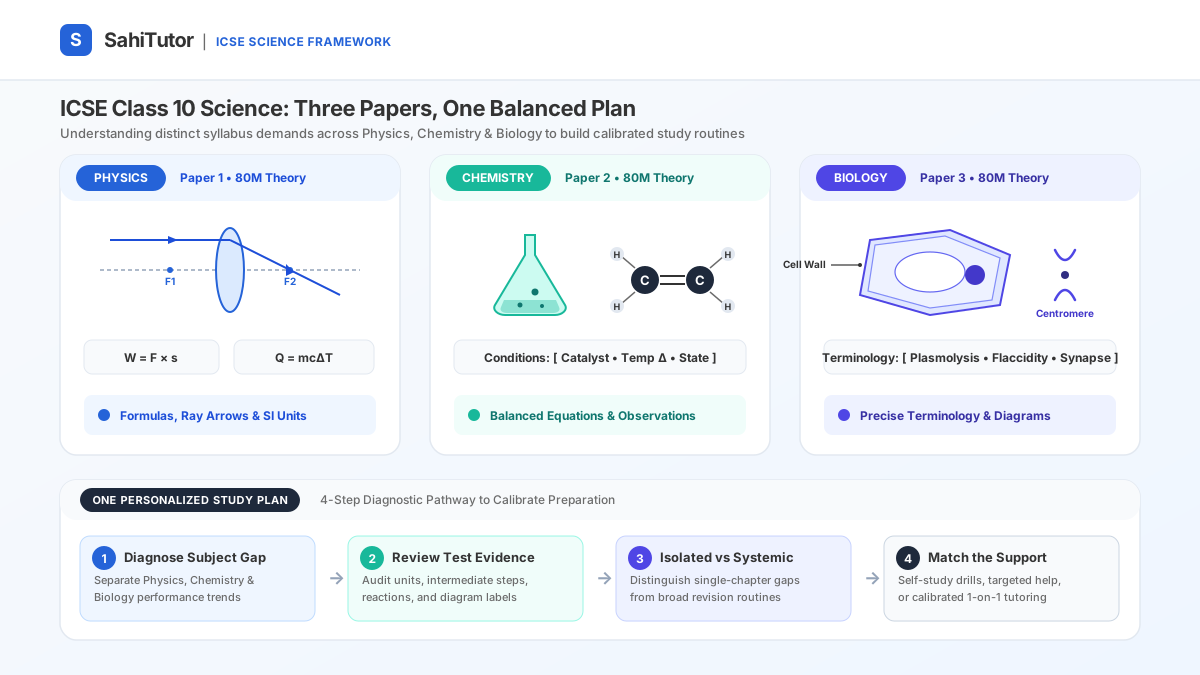
- The ICSE Science Structure: Three Distinct Papers Under One Subject
- Physics (Paper 1): Formulas, Numericals, and Examiner Observations
- Chemistry (Paper 2): Balanced Equations, Conditions, and Observations
- Biology (Paper 3): Precise Terminology and Diagram Conventions
- A 4-Step Diagnostic Framework for Parents: Matching the Right Support
- References & Authoritative Sources
The ICSE Science Structure: Three Distinct Papers Under One Subject
In the Indian Certificate of Secondary Education (ICSE) Class 10 examination conducted by the Council for the Indian School Certificate Examinations (CISCE), Science occupies a distinctive structural position. Categorized under Group II compulsory subjects, Science is not examined as a single blended test paper. Instead, candidates sit for three separate written examinations on different dates:
- Science Paper 1: Physics (2 hours, 80 marks external examination + 20 marks internal assessment)
- Science Paper 2: Chemistry (2 hours, 80 marks external examination + 20 marks internal assessment)
- Science Paper 3: Biology (2 hours, 80 marks external examination + 20 marks internal assessment)
Under official CISCE examination regulations, each paper is evaluated out of 100 marks (combining the 80-mark written theory paper with the school-evaluated 20-mark internal practical assessment). On the final ICSE Statement of Marks, the candidate's result in the subject 'Science' is determined by calculating the arithmetic average of the marks obtained across all three component disciplines.
This tripartite structure creates a specific learning dynamic. Because Physics, Chemistry, and Biology demand fundamentally different cognitive skills—mathematical deduction and optical geometry in Physics, symbolic equations and observational accuracy in Chemistry, and descriptive taxonomy and physiological diagramming in Biology—treating Science as a single monolithic subject during revision often leads to uneven preparation.
Furthermore, generic preparation may not always address the specific requirements of the ICSE syllabus and marking approach. CISCE examination papers follow defined conventions regarding command words, step-wise working, chemical conditions, and technical terminology. Understanding how these expectations operate across each separate paper is the first step toward building a balanced, realistic study routine.
Physics (Paper 1): Formulas, Numericals, and Examiner Observations
Science Paper 1 (Physics) tests candidates across key foundational domains: Force, Work, Power and Energy; Light (Refraction, Lenses, Spectrum); Sound; Electricity and Magnetism; Heat (Calorimetry); and Modern Physics (Radioactivity). The 80-mark theory paper is divided into two sections: Section I (40 marks, compulsory short-answer questions) and Section II (40 marks, where candidates choose 4 out of 6 multi-part questions).
A rigorous analysis of CISCE's official Analysis of Pupil Performance reports reveals several consistent areas where candidates lose marks in Physics, often despite knowing the broad concepts:
When evaluating a student's preparation in Physics, a tutor or parent should observe whether difficulties stem from conceptual misunderstandings (such as confusing the moment of a force with work) or from computational execution (such as decimal arithmetic under time limits). Targeted 1-on-1 review allows an educator to trace a student's calculations line-by-line, providing immediate feedback on presentation and unit consistency before habits solidify.
CISCE examiner reports consistently emphasize that Physics marks depend not merely on recalling a final answer, but on showing correct intermediate formula substitution, complete directional ray arrows, and proper SI units.
Chemistry (Paper 2): Balanced Equations, Conditions, and Observations
Science Paper 2 (Chemistry) evaluates candidates on Periodic Trends, Chemical Bonding, Acids, Bases and Salts, Analytical Chemistry, the Mole Concept and Stoichiometry, Electrolysis, Metallurgy, the Study of Specific Compounds (Hydrogen Chloride, Ammonia, Nitric Acid, and Sulphuric Acid), and Organic Chemistry.
Unlike general science tests that accept conceptual paraphrasing, ICSE Chemistry requires strict fidelity to chemical conventions. CISCE's Analysis of Pupil Performance highlights recurring candidate challenges across several topics:
A useful pedagogical approach used in 1-on-1 tutoring is maintaining a dedicated 'Observation and Reagent Log.' Rather than cramming reactions passively, students practice writing paired entries: the balanced chemical equation on one side, and the precise sensory observations (color shifts, precipitate solubility, gas characteristics) on the other.
Biology (Paper 3): Precise Terminology and Diagram Conventions
Science Paper 3 (Biology) covers Cell Division (mitosis and cell cycle), Basic Genetics, Plant Physiology (water absorption, transpiration, photosynthesis), Human Anatomy and Physiology (circulatory, excretory, nervous, endocrine, and reproductive systems), Population, and Environmental Pollution.
Because Biology is sometimes mistakenly perceived as a subject requiring only rote reading, candidates are often caught off guard by the precision required in ICSE examinations. Official CISCE examiner analysis highlights the following common error patterns:
In a one-on-one learning environment, a tutor can review a student's diagrams directly, ensuring that anatomical proportions are accurate and that biological definitions hinge on functional mechanisms rather than vague conversational approximations.
A 4-Step Diagnostic Framework for Parents: Matching the Right Support
When a child's marks in school science assessments fluctuate, parents often wonder whether extra help is needed, and if so, what format is most appropriate. Arranging five days of multi-subject tuition without an assessment can lead to unnecessary fatigue and reduced self-study time.
The following 4-step framework helps families evaluate their student's genuine learning needs objectively:
References & Authoritative Sources
The curriculum frameworks, examination structures, and examiner observations cited throughout this article are drawn directly from official regulatory publications released by the Council for the Indian School Certificate Examinations (CISCE):
References & Authoritative Sources
To maintain factual integrity, SahiTutor grounds research-informed statements in official curriculum frameworks, educational examination boards, and peer-reviewed educational literature.
- ICSE Regulations and Syllabuses: Science (Physics, Chemistry, Biology) — Council for the Indian School Certificate Examinations (CISCE)
- Analysis of Pupil Performance: ICSE Examination (Physics, Chemistry, Biology) — Council for the Indian School Certificate Examinations (CISCE) Research & Publications
- Specimen Question Papers: ICSE Class X Science Papers 1, 2, and 3 — Council for the Indian School Certificate Examinations (CISCE)
Looking for personalized support in ICSE Class 10 Physics, Chemistry, or Biology? SahiTutor connects families with verified subject specialists for 1-on-1 online and home tutoring tailored to your child's learning goals.
Submit a free requirement in under 60 seconds. We'll find qualified tutors matching your location, curriculum, and budget, and arrange a trial demo class.
Related Guides & Articles
View allCBSE Class 12 Physics: Mastering Key Derivations and Numericals with a Private Tutor
Master the top 30 CBSE Class 12 Physics derivations and tricky numericals with step-marking techniques and dedicated 1-on-1 private tuition.
How Many Days a Week Should Your Child Have Home Tuition? (3 Days vs 5 Days Guide)
Should your child have home tuition 3 days or 5 days a week? Compare scheduling trade-offs, fatigue factors, and use our practical 4-step decision framework.
Class 10 & 12 Board Exam Prep: How a Private Home Tutor Boosts Scores by 20–30%
Proven study blueprints, syllabus timelines, and revision routines for CBSE & ICSE Class 10 & 12 board exams. Learn how dedicated private tutoring eliminates exam anxiety.