

How to Make Revision Notes From a Textbook Chapter
Make useful revision notes from a textbook chapter. Choose key ideas, turn them into practice questions and check your notes with a worked maths example.
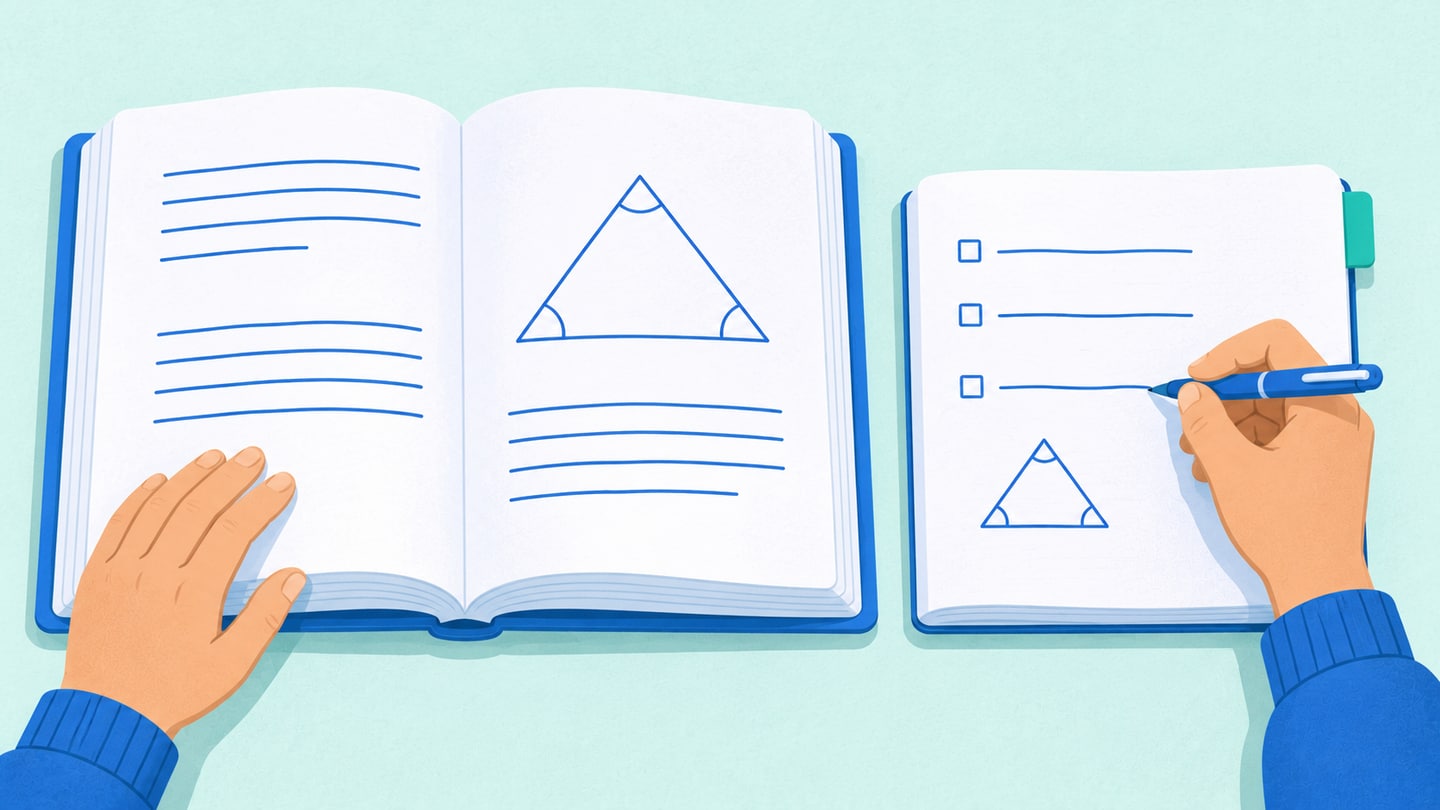
Choose one section and decide what you need to do
To make revision notes from a textbook, choose a small section, write the main ideas in your own words and add a question you can answer later. Then close the book, try the question and check your answer. This guide is for secondary-school students whose notes keep growing while practice questions remain unfinished.
Start with the chapter section your teacher has assigned or the part you need for an upcoming assessment. Read the heading, any learning goals and a sample question. Decide what you want to be able to explain, calculate, compare or label by the end. If the test scope is unclear, ask your teacher before summarising the whole chapter.
Write the section title and page reference at the top of your notes. Keep the reference so you can return to a diagram, definition or worked example when you need the full explanation.
Choose the information that helps you answer a question
Read a short passage before writing. Pause and explain its main idea aloud or in one rough sentence. Then record the terms, steps or examples you would need to answer a question about it. Compare your wording with the original so you do not lose an important condition.
For a definition, retain the precise terms your course uses. For a process, show the stages and how one leads to the next. For a calculation, record when to use the method, a short worked example and the step you tend to miss. If an abbreviation would be unclear next week, write it out.
Avoid setting a page limit before you understand the section. Aim for enough detail to use the notes. If you have copied most of a passage, ask which parts explain the central idea and which examples you can find again using the page reference.
Turn a heading into a question and a checkable answer
Suppose your maths section is about solving equations with brackets. A note such as “expand, collect terms, solve” names the steps, but gives you little to practise. Add a question and enough working to check your method.
Practice question. Solve 3(x + 2) = 18. Expand to get 3x + 6 = 18, subtract 6 from both sides to get 3x = 12, then divide both sides by 3 to get x = 4. Substitute to check. The left side becomes 3(4 + 2) = 18, which matches the right side.
Alongside the working, write a prompt such as “Which operation will remove the added 6 while keeping both sides equal?” Cover the answer when you return to it. For a fresh attempt, solve 2(y + 3) = 14. Expanding gives 2y + 6 = 14, so 2y = 8 and y = 4. Substitution gives 2(4 + 3) = 14.
Use the same approach in another subject. For a history section, turn the heading into a question about a cause or consequence, then note one specific detail and what it shows. Our guide to answering explain questions in history gives a worked paragraph.
Give each diagram or comparison a task
Include a diagram when it helps you identify parts, follow a sequence or explain a relationship. Add a prompt beside it, such as “Label the parts without looking” or “Explain what changes between the first and last stage”. Check labels and arrow directions against your textbook.
For a comparison, choose a shared feature and write what each item does in relation to that feature. Then practise explaining one difference without reading the notes. Add the detail you could not recall after checking the source.
Keep colour and layout simple enough that you have time to try the task. If you find yourself decorating a page before understanding the explanation, pause and attempt one question from that section.
Use an attempted answer to decide what to add
Put the textbook and notes aside and attempt your prompt. Reopen them to check what you omitted, misunderstood or needed a hint for. Correct the relevant line and mark one question to retry. If you cannot explain the correction, take that question to your teacher.
For example, if you wrote 3(x + 2) as 3x + 2, add “multiply both terms inside the brackets” beside the example. Try a different expression to see whether you can apply the correction. A page of extra copied examples may leave the same step unresolved.
Schedule that retry as a small task in your two-week revision plan. If you also have a marked paper, the maths mock-test review guide shows how to find the first wrong step and choose practice.
- Can I say what this section helps me do?
- Have I kept the terms, conditions and steps I need?
- Can I find the full source explanation using the page reference?
- Does the page include a question I can attempt independently?
- Have I checked an answer and recorded the next step?
If you can copy a method but struggle to use it independently, share the topic and your attempt when discussing a suitable tutor with SahiTutor.
Submit a free requirement in under 60 seconds. We'll find qualified tutors matching your location, curriculum, and budget, and arrange a trial demo class.
Related Guides & Articles
View allHow to Turn a Syllabus Into a Two-Week Revision Plan
Build a two-week revision plan from your syllabus. Pick topics to study first, fit practice around schoolwork, and update your plan using your answers.
How to Review a Maths Mock Test and Plan Your Next Revision
Turn a marked maths mock test into a practical revision plan. Find the first wrong step, choose targeted practice and check your correction with a fresh question.
How to Answer ‘Explain’ Questions in History
Learn to answer explain questions in secondary-school history. Build a paragraph with evidence, see a worked example and check your own practice answer.