

How to Turn a Syllabus Into a Two-Week Revision Plan
Build a two-week revision plan from your syllabus. Pick topics to study first, fit practice around schoolwork, and update your plan using your answers.
Turn the syllabus into a list of tasks
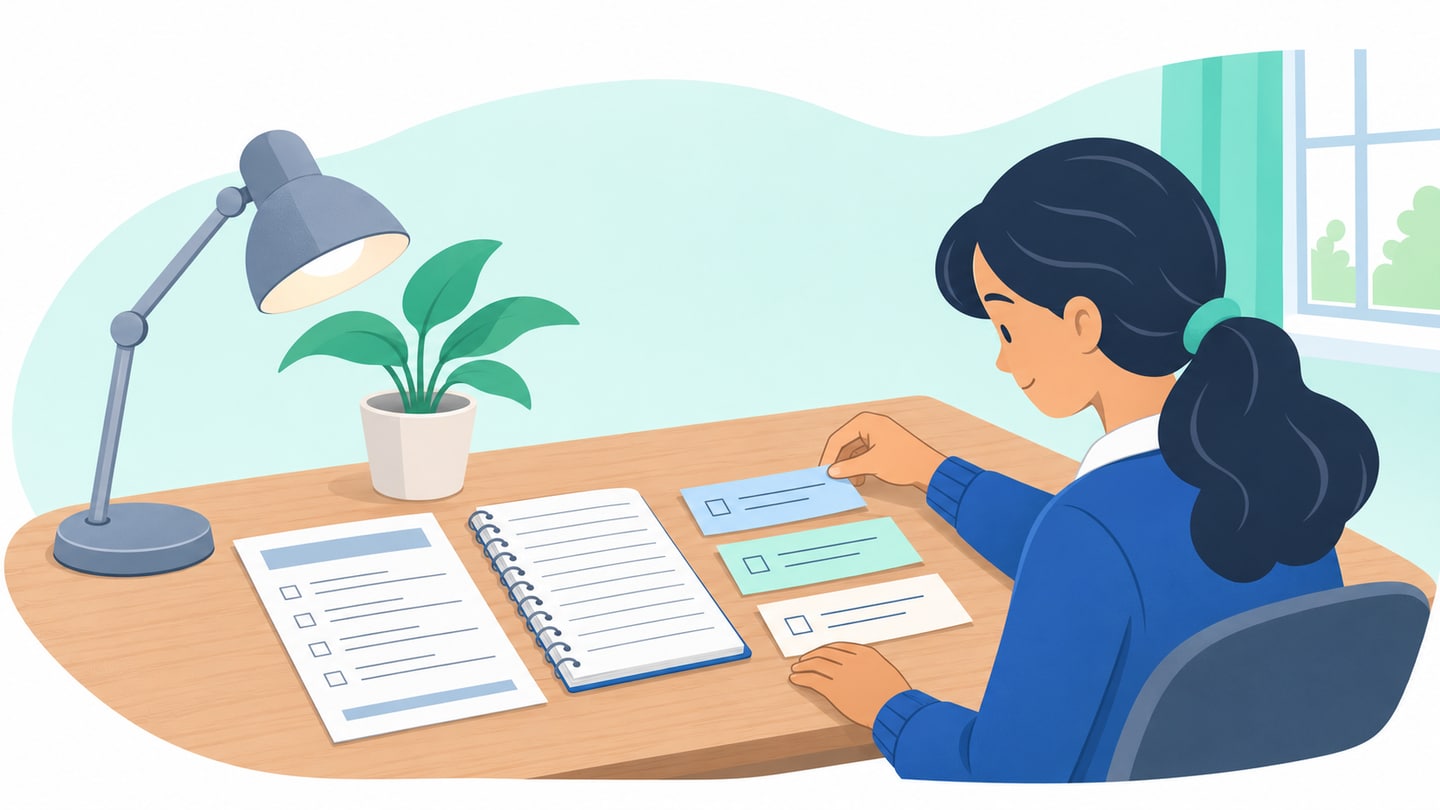
If you have two weeks before a secondary-school assessment, turn your syllabus into a short list of things you need to do. Try a question to see where you get stuck, give the hardest useful tasks their own study slots and keep a slot free to catch up or practise again.
Start with the syllabus or topic list that applies to your class and assessment. A school test may cover only part of a course, so check the scope with your teacher if it is unclear. Write each topic as something you can do. Change “graphs” to “read a graph, calculate a gradient and explain what the gradient means”.
Keep the list short enough to scan. A broad heading can become two or three tasks. For a history topic, you might write “put the main events in order” and “explain two causes using specific evidence”. Add the matching textbook pages, class notes or questions so you know where to start.
Choose what to study first
Try one short question or explain the topic from memory before rating it. Mark each task “can do”, “needs practice” or “need help”. Use the result of your attempt to choose the label. Familiar words on a page can feel reassuring, so give yourself a concrete task to check.
Start with topics that are in scope, still difficult and needed for other questions. For example, if you can read values from a graph but cannot choose two points for a gradient, practise that step before moving to questions that ask you to interpret the result. If you cannot start a topic at all, write down one question to take to your teacher.
Build a two-week timetable around your commitments
List the time you can actually use after school, homework and other commitments. For example, if you have three 30-minute slots each week, plan for six slots. Give each one a task and a finish line, such as “attempt three gradient questions and correct the first wrong step”. A short, specific session is easier to move when your week changes.
Use the first week to check your starting point and work through the biggest gaps. In the second week, try a mixed set and revisit the errors. The six-slot example below is a starting point. Move the sessions around your own workload.
- Week 1, slot 1 — map the syllabus and try a few short questions.
- Week 1, slot 2 — practise one priority topic and record the step that needs work.
- Week 1, slot 3 — try a second topic and return briefly to the first.
- Week 2, slot 1 — attempt a small mixed set covering both topics.
- Week 2, slot 2 — correct the mixed set and retry a similar question.
- Week 2, slot 3 — review remaining gaps or use this slot for work that moved.
Update the plan using your answers
At the end of a session, write what you could do independently and what still needed a hint. If you can complete a fresh question, move that task into a later check. If the same step keeps going wrong, give it a shorter, more focused task next time.
When a session moves, check whether the task still belongs at the top of the list. A buffer can absorb a missed session. If time gets tight, choose the most useful remaining task and leave the lower-priority ones for later. Our mock-test review guide walks through turning a wrong answer into a practice task.
If the plan keeps colliding with regular assignments, review our guide to balancing school homework and tuition. A revision plan should reflect the time you have and the work your next assessment calls for.
If a topic keeps holding up your revision, share your subject, level and lesson preferences with SahiTutor to discuss a suitable tutor.
Submit a free requirement in under 60 seconds. We'll find qualified tutors matching your location, curriculum, and budget, and arrange a trial demo class.
Related Guides & Articles
View allHow to Review a Maths Mock Test and Plan Your Next Revision
Turn a marked maths mock test into a practical revision plan. Find the first wrong step, choose targeted practice and check your correction with a fresh question.
How to Balance School Homework and Home Tuition Without Overwhelming Your Child
A practical, evidence-assisted guide for parents and tutors to coordinate school assignments with private tuition, prevent unnecessary duplicate work, and protect student rest.
What to Share With a Tutor Before the First Lesson
Use this practical checklist to share a learner’s goals, current topics, sticking points, materials, schedule and lesson preferences before tutoring begins.