UP Board English-Medium Students: When Can 1-on-1 Home Tuition Help?
Explore the unique challenges UP Board English-medium students face with NCERT curricula and how verified 1-on-1 home tutors bridge key conceptual gaps.
- The Rise of English-Medium Stream in UP Board
- 3 Specific Academic Hurdles English-Medium UP Board Students Face
- How 1-on-1 Home Tutoring Bridges NCERT Concepts & Exam Style
- When Self-Study Is Sufficient vs. When a Personal Tutor Is Needed
- Parent Checklist: What to Look for in a UP Board English-Medium Tutor
Over the past decade, the Uttar Pradesh Madhyamik Shiksha Parishad (UPMSP)—commonly known as the UP Board—has undergone one of the largest structural transformations in Indian state education. Following the phased adoption of National Council of Educational Research and Training (<a href='https://ncert.nic.in' target='_blank' rel='noopener noreferrer' class='text-primary hover:underline font-medium'>NCERT</a>) textbooks for High School (Classes 9–10) and Intermediate (Classes 11–12) in core subjects like Mathematics, Physics, Chemistry, and Biology, thousands of families across Uttar Pradesh have opted to enroll their children in English-medium streams.
In educational hubs such as Lucknow, Kanpur, Prayagraj, Varanasi, and Gorakhpur, schools affiliated with the UP Board increasingly operate dedicated English-medium sections. Parents recognize the long-term advantages: studying NCERT science and mathematics in English prepares students directly for national competitive examinations such as JEE, NEET, and CUET, while benefiting from the regional examination structure and affordable fee schedules of state-affiliated schooling.
However, this academic choice brings a distinct set of operational and pedagogical challenges. While the textbook curriculum is identical to CBSE, the instructional ecosystem, teacher availability, classroom language dynamics, and examination paper formats differ markedly from central boards. Understanding these realities is crucial for parents evaluating how best to support their child's daily learning.
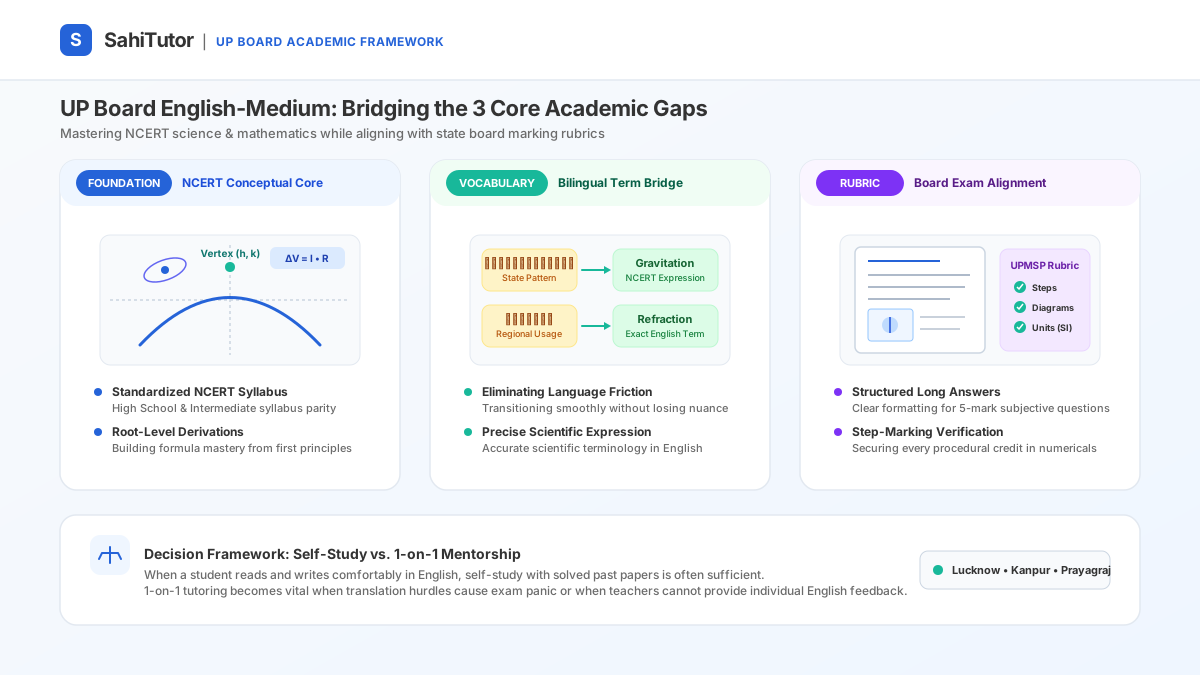
Through parent consultations across Lucknow, Kanpur, Prayagraj, and Varanasi, SahiTutor academic advisors consistently observe three structural bottlenecks that English-medium UP Board students navigate:
<strong>1. Vernacular Classroom Instruction vs. English Examination Papers:</strong> In many government-aided and private UP Board schools, classroom teachers are primarily accustomed to lecturing in Hindi. Consequently, while textbooks and question papers are printed in English, classroom explanations often occur in mixed Hindi or colloquial terms. Students grasp the general intuition but struggle to translate that understanding into formal scientific English sentences, exact chemical definitions, or standardized mathematical proofs during written assessments.
<strong>2. Scarcity of Tailored English-Medium Study Materials:</strong> The publishing market for UP Board preparation is heavily dominated by Hindi-medium model papers, un-solved question banks ('Vidya Question Bank', 'Avatar', etc.). While CBSE English-medium question banks exist in abundance, they follow CBSE-specific question blueprints (assertion-reasoning, case-based data analysis). UPMSP examination papers maintain their own distinctive pattern: rigorous 1-mark objective questions, 2-mark short conceptual notes, and extensive 5-mark long-answer derivations with internal choices. Finding English-medium resources that perfectly match UPMSP examination rubrics is a persistent challenge.
<strong>3. Timed Answer-Writing & Technical Diagram Labeling:</strong> UP Board examination rubrics heavily emphasize structured step presentation, formal statements of given data, formula citations, and hand-drawn diagrams with bilingual or accurate English annotations. Students who think in Hindi but must write under strict time constraints in English frequently experience cognitive bottlenecking, leading to incomplete papers despite knowing the underlying concepts.
A student rarely struggles because NCERT concepts are too complex; they struggle when the language of thought does not smoothly translate into the language of the examination paper.
In large batch coaching institutes, students are taught in homogeneous, fast-paced environments where individual language friction is rarely addressed. A teacher cannot pause a 60-student batch to help one student articulate why a ray refracts towards the normal in English rather than Hindi.
This is where a verified, 1-on-1 home tutor provides decisive academic leverage:
At SahiTutor, our editorial standard is grounded in honest educational decision-making: 1-on-1 home tuition is neither universally necessary for every child nor a substitute for consistent self-study. Parents should assess their child's specific academic indicators before hiring a private educator:
<strong>When Self-Study and School Guidance Are Sufficient:</strong>
<strong>When 1-on-1 Home Tutoring Becomes Highly Valuable:</strong>
Finding an educator who excels at teaching UP Board students in English requires asking the right questions during initial evaluations. Because many private tutors in Uttar Pradesh specialize exclusively in either pure CBSE English or pure UP Board Hindi, parents should verify specific educator competencies:
Before confirming an ongoing tutoring arrangement, use this structured evaluation checklist:
References & Authoritative Sources
To maintain factual integrity, SahiTutor grounds research-informed statements in official curriculum frameworks, educational examination boards, and peer-reviewed educational literature.
- UPMSP High School & Intermediate Examination Regulations & Curriculum — Uttar Pradesh Madhyamik Shiksha Parishad (UPMSP)
- National Curriculum Framework for School Education (NCF-SE) — National Council of Educational Research and Training (NCERT)
- National Education Policy (NEP 2020) — Multilingualism and Board Examination Reforms — Ministry of Education, Government of India
Find a verified UP Board English-medium home tutor in Lucknow, Kanpur, Prayagraj, or Varanasi.
Submit a free requirement in under 60 seconds. We'll find qualified tutors matching your location, curriculum, and budget, and arrange a trial demo class.
Related Guides & Articles
View allCBSE Class 10 Maths: Why 1-on-1 Tutoring Solves Pre-Board Anxiety
Discover how personalized 1-on-1 tutoring helps Class 10 students overcome Mathematics anxiety, master NCERT, and score 90%+ in CBSE board exams.
How Many Days a Week Should Your Child Have Home Tuition? (3 Days vs 5 Days Guide)
Should your child have home tuition 3 days or 5 days a week? Compare scheduling trade-offs, fatigue factors, and use our practical 4-step decision framework.
How to Choose the Right Home Tutor for Your Child: The Ultimate Parent Checklist (2026)
A step-by-step practical guide for parents on selecting the best home tutor or online tutor for CBSE, ICSE, or State Boards. Learn what questions to ask and how to evaluate demo classes.