

How to Convert km/h to m/s in Physics Questions
Learn why you divide by 3.6 to convert km/h to m/s. Follow a worked physics question, avoid common unit mistakes and check your answers with three practice problems.
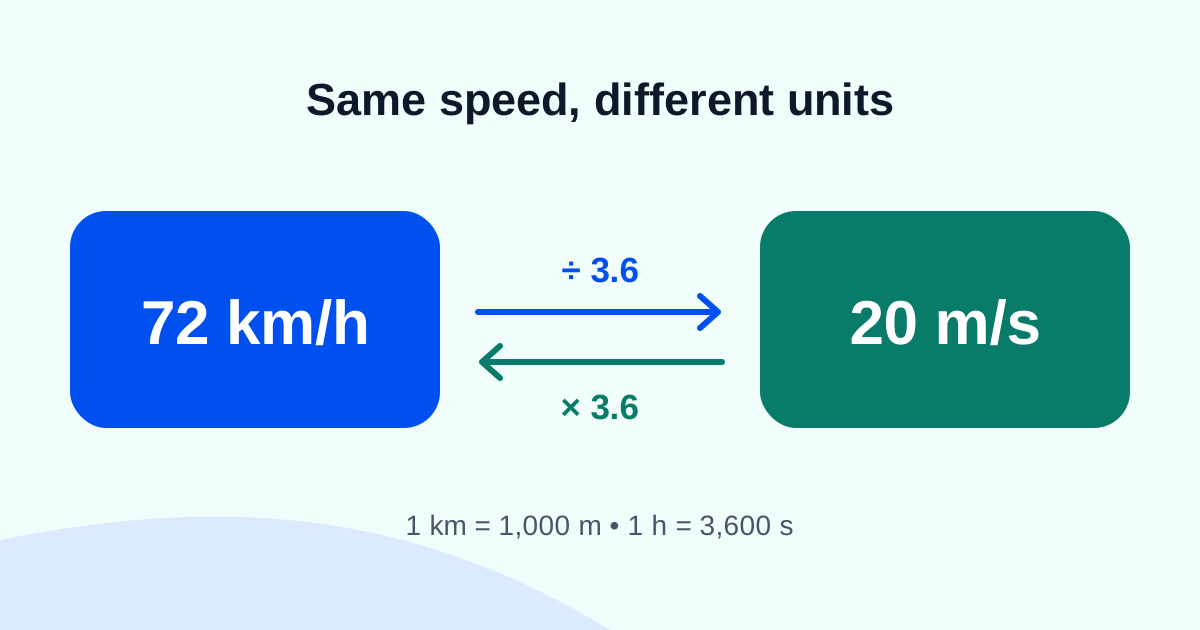
Convert km/h to m/s by dividing by 3.6
Divide the speed in kilometres per hour by 3.6 to get metres per second. For example, 72 km/h ÷ 3.6 = 20 m/s. To convert in the other direction, multiply by 3.6.
If a school physics question gives speed in km/h and time in seconds, convert the speed to m/s before calculating distance in metres. Write the unit you need beside the question. That gives you a way to check the calculation before you reach the answer.
Work out where 3.6 comes from
One kilometre is 1,000 metres and one hour is 3,600 seconds. So 1 km/h is 1,000 m divided by 3,600 s, which simplifies to 5/18 m/s. Multiplying by 5/18 gives the same result as dividing by 3.6.
To convert 72 km/h with the units visible, write 72 km/h × (1,000 m / 1 km) × (1 h / 3,600 s). Kilometres and hours cancel, leaving metres per second. Set up the factors this way if you forget which operation to use.
The two units express the same physical speed. The NIST guide to the SI illustrates this with 25 m/s and 90 km/h. Converting a value back to its starting unit gives you a quick check.
Use the converted speed to find distance
A cyclist travels at a constant 18 km/h for 24 seconds. How far does the cyclist travel in metres?
First divide 18 by 3.6 to get 5 m/s. Then multiply speed by time. The distance is 5 m/s × 24 s = 120 m. The seconds cancel, leaving metres.
For a reasonableness check, imagine 24 groups of 5 metres. They add to 120 metres. The same calculation in kilometres and hours would be 18 km/h × (24/3,600) h = 0.12 km, which is also 120 m.
Check the direction and the units
If you multiply 72 by 3.6 while converting to m/s, you get 259.2. Multiplying that result by 3.6 to go back does not return 72 km/h. Rebuild the conversion with metres per kilometre and seconds per hour if you lose track of the direction.
Use 3.6 for km/h and m/s. If the question gives metres per minute, the length is already in metres. For example, 180 m/min is 180 metres in 60 seconds, which equals 3 m/s.
Keep the units beside the numbers. If a distance calculation still has seconds in its denominator, look for a missing time factor or a mismatched unit.
Try three practice questions
Convert 54 km/h to m/s. Convert 12.5 m/s to km/h. Then find the distance in metres covered in 8 seconds at a constant 36 km/h.
Check your working. 54 ÷ 3.6 gives 15 m/s. 12.5 × 3.6 gives 45 km/h. For the distance question, 36 ÷ 3.6 gives 10 m/s and 10 × 8 gives 80 m.
If you missed a question, mark the first line where the units stopped matching and try a fresh set of numbers. The maths mock-test review guide shows how to turn that correction into a specific practice task.
References & Authoritative Sources
To maintain factual integrity, SahiTutor grounds research-informed statements in official curriculum frameworks, educational examination boards, and peer-reviewed educational literature.
- The International System of Units, Section 2 — NIST Special Publication 330 (2019)
Supports: “Metres per second and kilometres per hour are alternative units of speed, with 25 m/s equivalent to 90 km/h.”
Looking for help with school physics? Share your level, topic and lesson preferences with SahiTutor to discuss a suitable tutor.
Submit a free requirement in under 60 seconds. We'll find qualified tutors matching your location, curriculum, and budget, and arrange a trial demo class.
Related Guides & Articles
View allHow to Review a Maths Mock Test and Plan Your Next Revision
Turn a marked maths mock test into a practical revision plan. Find the first wrong step, choose targeted practice and check your correction with a fresh question.
CBSE Class 12 Physics: Mastering Key Derivations and Numericals with a Private Tutor
Master the top 30 CBSE Class 12 Physics derivations and tricky numericals with step-marking techniques and dedicated 1-on-1 private tuition.
ICSE Class 10 Science (Physics, Chem, Bio): How 1-on-1 Tutoring Can Support Exam Preparation
Master ICSE Class 10 Science. Explore CISCE exam structures, examiner insights for Physics, Chemistry, and Biology, and a practical 4-step diagnostic framework.