
Navigating AP Sciences: A Strategic Approach to AP Chemistry and Physics
Discover a strategic approach to mastering AP Chemistry and AP Physics. Learn how targeted 1-on-1 tutoring can help students navigate the rigorous College Board curriculum.
Advanced Placement (AP) science courses, particularly AP Chemistry and AP Physics, are renowned for their rigor. Designed by the College Board to reflect college-level coursework, these classes present a significant leap in difficulty for high school students.
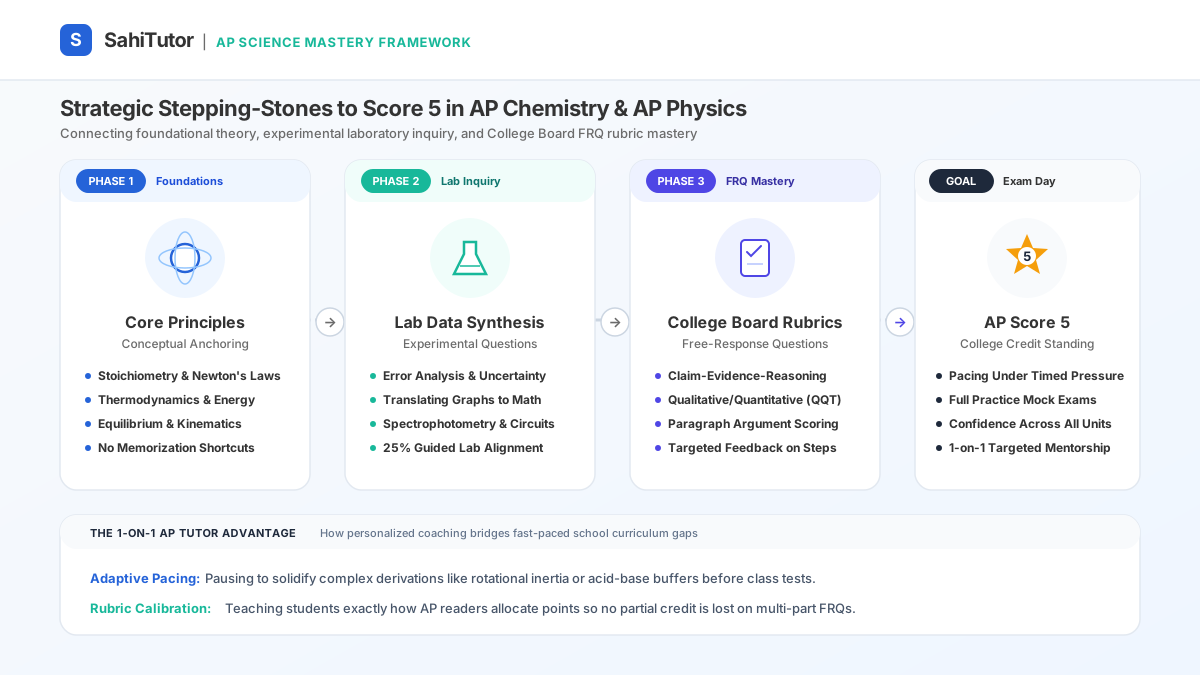
Success in these courses requires more than just memorizing facts; it demands deep conceptual understanding, advanced problem-solving skills, and the ability to apply scientific principles to complex scenarios.
The AP Chemistry curriculum is extensive, covering topics from atomic structure and intermolecular forces to thermodynamics and equilibrium. A common pitfall is attempting to memorize chemical reactions without understanding the underlying mechanisms.
The Free-Response Questions (FRQs) in the AP exam heavily test a student's ability to articulate scientific reasoning and perform multi-step calculations accurately.
Whether it is AP Physics 1 (algebra-based) or AP Physics C (calculus-based), the core challenge remains the same: translating physical phenomena into mathematical models.
Students often struggle with kinematics and electromagnetism because they require visualizing abstract concepts. Success hinges on consistent practice with varied problem sets to recognize patterns in how physical laws are applied.
A unique aspect of AP sciences is the substantial laboratory requirement, which accounts for at least 25% of instructional time. Balancing lab reports with ongoing coursework and exam preparation requires excellent time management.
Students must learn to synthesize their hands-on lab experiences with theoretical knowledge, as the AP exams frequently feature inquiry-based questions derived from laboratory contexts.
The fast pace of AP classrooms can sometimes leave students struggling with foundational concepts. A 1-on-1 tutor can provide the necessary pacing adjustments, pausing to solidify difficult topics like rotational mechanics or acid-base equilibria.
Furthermore, a tutor experienced with the College Board rubrics can provide targeted feedback on practice FRQs, helping students refine their answers to meet the specific grading criteria required for a top score.
References & Authoritative Sources
To maintain factual integrity, SahiTutor grounds research-informed statements in official curriculum frameworks, educational examination boards, and peer-reviewed educational literature.
- AP Chemistry Course and Exam Description — College Board
- AP Physics 1: Algebra-Based Course and Exam Description — College Board
Ensure your child is fully prepared for the rigor of AP Sciences. Connect with a specialized SahiTutor educator for targeted 1-on-1 support.
Submit a free requirement in under 60 seconds. We'll find qualified tutors matching your location, curriculum, and budget, and arrange a trial demo class.
Related Guides & Articles
View allIGCSE vs. IB Middle Years Programme: Choosing the Right Pathway for Your Child
Understand the core differences between the Cambridge IGCSE and the IB Middle Years Programme to make an informed decision for your child's education.
NEET Foundation in Classes 9–10: 1-on-1 Tutoring vs. Batch Coaching
Examine the trade-offs in pacing, student stress, and conceptual retention between large coaching batches and 1-on-1 mentoring for NEET foundation.
Does a Primary School Child (Classes 1–5) Really Need a Home Tutor? Honest Parent Guide
An honest evaluation of when primary school students (Classes 1–5) benefit from a home tutor for reading fluency and habits, and when self-directed play is enough.