

NCEA Level 3 Mathematics: How to Structure Your Study for Excellence Credits
A guide for New Zealand students to navigate NCEA Level 3 Mathematics. Learn how targeted study strategies and mentorship can help secure Excellence credits.
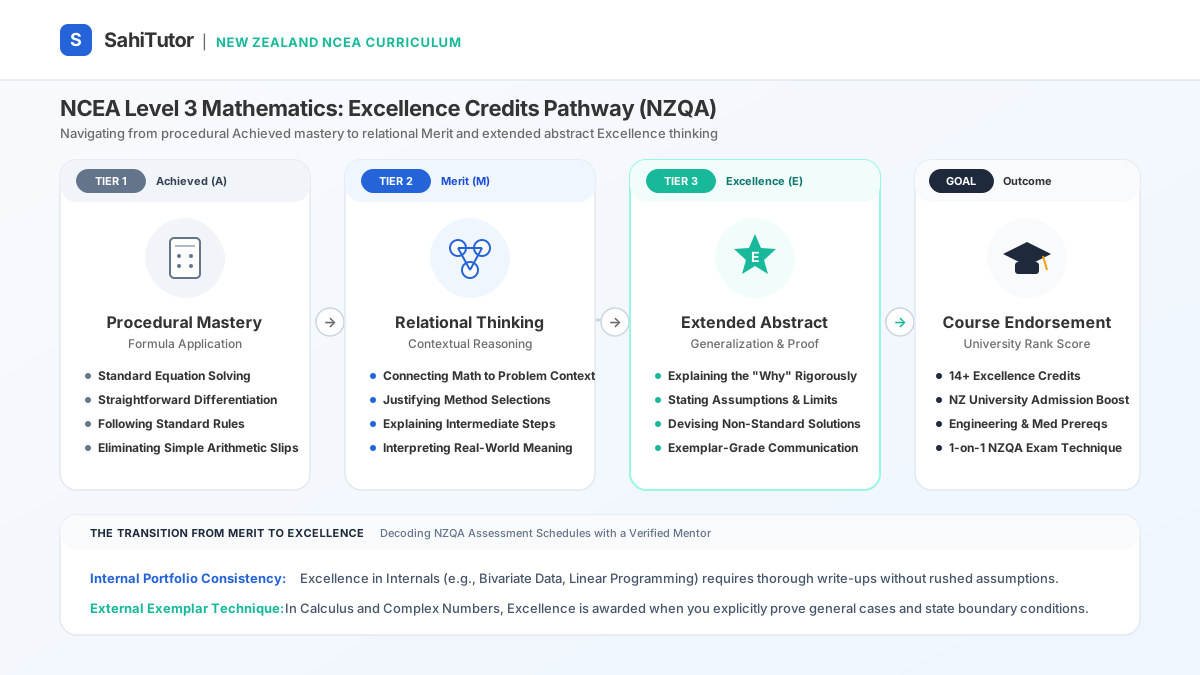
The National Certificate of Educational Achievement (NCEA) Level 3 is the final step in New Zealand secondary schooling, heavily influencing university entrance (UE) and subject prerequisites.
Unlike systems based purely on percentages, NCEA assesses students against specific Achievement Standards, grading them as Achieved (A), Merit (M), or Excellence (E).
At Level 3, Mathematics typically splits into two distinct domains: Calculus and Statistics. Calculus focuses heavily on differentiation, integration, and complex numbers, making it essential for engineering and physical science pathways.
Statistics involves probability concepts, time series analysis, and bivariate data. It is widely applicable across the social sciences, commerce, and health sciences.
Securing an Excellence grade requires demonstrating abstract thinking and comprehensive understanding. According to NZQA guidelines, students must typically link concepts, solve multi-step problems in context, and justify their mathematical reasoning.
Rote learning formulas will only secure an Achieved grade. Excellence demands the ability to interpret a novel problem, select the appropriate mathematical tool, and clearly communicate the solution process.
NCEA relies on a mix of Internal Assessments (conducted throughout the year) and External Assessments (end-of-year exams).
Internals often involve extended investigations and report writing, requiring sustained effort and careful adherence to the marking schedule. Externals demand strong exam technique and the ability to perform under time pressure.
The step up from Level 2 to Level 3 Mathematics can be significant. A tutor familiar with the NZQA framework can provide targeted support, especially for students aiming to transition from Merit to Excellence.
A tutor can help decode the specific requirements of the assessment schedules, ensuring students understand exactly what is required to demonstrate relational and abstract thinking in their internals and externals.
References & Authoritative Sources
To maintain factual integrity, SahiTutor grounds research-informed statements in official curriculum frameworks, educational examination boards, and peer-reviewed educational literature.
- Mathematics and Statistics Achievement Standards — New Zealand Qualifications Authority (NZQA)
Aiming for Excellence endorsements in NCEA Level 3 Maths? Connect with a specialized SahiTutor educator to refine your exam technique.
Submit a free requirement in under 60 seconds. We'll find qualified tutors matching your location, curriculum, and budget, and arrange a trial demo class.
Related Guides & Articles
View allNavigating AP Sciences: A Strategic Approach to AP Chemistry and Physics
Discover a strategic approach to mastering AP Chemistry and AP Physics. Learn how targeted 1-on-1 tutoring can help students navigate the rigorous College Board curriculum.
IGCSE vs. IB Middle Years Programme: Choosing the Right Pathway for Your Child
Understand the core differences between the Cambridge IGCSE and the IB Middle Years Programme to make an informed decision for your child's education.
NEET Foundation in Classes 9–10: 1-on-1 Tutoring vs. Batch Coaching
Examine the trade-offs in pacing, student stress, and conceptual retention between large coaching batches and 1-on-1 mentoring for NEET foundation.